
This post may contain affiliate links. As an Amazon Associate, I earn from qualifying purchases.
Create Your Own Signature Scent: An Easy Step-by-Step Guide to DIY Perfume with Essential Oils!
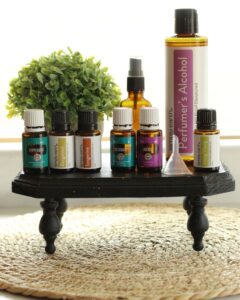
In this article, we’ll dabble in the world of DIY perfume, using all-natural essential oil blends to create unique and personalized scents that last.
But don’t worry, you don’t need to be a chemist to create your own unique scent. In this article, we will guide you through the basics of essential oil perfume spray, helping you to create a fragrance that not only smells great, but is also safe for your skin and the environment.
DIY Perfume with Essential Oils
Equipment
- 2 oz. glass small spray bottle (60 ml bottle)
- small funnel
Ingredients
- up to 50 drops total of essential oils 3-5 types for layering
- perfumer’s alcohol
Instructions
- Decide on a blend of your favorite essential oils. I recommend using 3 to 5 types of oils incorporating a blend of 30% top notes, 50% middle notes, and 20% base notes.
- Using a small funnel, put desired amount of each essential oil into your glass bottle. Add in perfumer’s alcohol to fill bottle. Secure the lid of the bottle and gently shake to combine.
- Allow the scent mixture to meld together for a couple weeks. *Note – the scent can change slightly after resting.
- After the resting period, test your scent. Adjust by adding additional drops of specific oils if needed.
- Always store in a cool, dark place.
- Give your glass spray bottle a little shake before using.
WHY MAKE YOUR OWN NATURAL DIY PERFUME?
Women are exposed to so many different chemicals every day, just from their personal care products. That has many seeking a more natural and safer alternative for their beauty routines.
In the past few years, there has been a lot of discussion about the effects of synthetic scents (or fragrances) on our health. Most of them are made from toxic chemicals linked to cancer, birth defects, central nervous system disorders, endocrine disruptors, and even allergic reactions. Check out this article from the EWG Website discussing the hidden chemicals in perfumes and colognes.
If you’re someone who wants to take control of what goes into your body or possibly have someone close to you that can’t tolerate synthetic fragrances, then learning how to make your own perfume with essential oils might be the perfect solution.
Also, creating your own custom fragrance can be rewarding and a lot of fun. Play around with different essential oils to personalize a scent unique to you. Check out my favorite blend below!
WHY USE ESSENTIAL OILS IN A DIY PERFUME?
Essential oils (not to be confused with fragrance oils) are concentrated extracts derived from plants, containing their natural fragrance and beneficial properties. These extracts are usually obtained through distillation or cold pressing techniques.
If you are looking for more of an explanation of what essential oils are and how they’re produced, here is an article that dives a little deeper.
I find it fascinating that essential oils go way back even into Biblical times. There are plenty of Scripture verses that mention them, but probably one of the most notable passages would be when the wise men brought gifts of gold, frankincense and myrrh to Baby Jesus.
The major reason people look to essential oils when creating a natural perfume is that they are a natural fragrance option that can have aromatic benefits as well.
UNDERSTANDING FRAGRANCE NOTES
Fragrance notes are the layers of scent within a perfume and how it evolves over time. Perfumes are typically structured with 3 types of fragrance notes:
- Top – the first scents you notice, but they also disappear quickly.
- ex. Citrus oils (lemon, orange, and grapefruit). Herbal oils (peppermint and eucalyptus).
- Middle – known as the “heart of the perfume.” They take longer to notice, but last longer than top notes.
- ex. Florals (lavender, rose, and ylang-ylang). Spicy oils (clove and cinnamon).
- Base – these stabilize the blend and give the scent the ability to linger.
- ex. Woodsy oils (sandalwood or cedarwood). Earthy oils (patchouli and vetiver). Sweet oils (vanilla).
The ideal combination for a well-balanced fragrance generally includes a ratio of 30% Top Notes, 50% Middle Notes, and 20% Base Notes.
SUPPLIES NEEDED
This is an easy DIY. It is inexpensive because you really don’t need anything fancy. If you already use essential oils and have some on hand, making this DIY perfume is way more affordable than store-bought perfumes. I’ve linked some of the products I personally use.
- 2 oz. glass small spray bottle (60 ml bottle)
- small funnel – the one I’ve linked comes with its own funnel
INGREDIENTS
- up to 50 drops total of essential oils (3-5 types for layering)
- perfumer’s alcohol
STEP-BY-STEP INSTRUCTIONS FOR DIY PERFUME WITH ESSENTIAL OILS
Choose your oils. Decide on a blend of your favorite essential oils. I recommend using 3 to 5 types of oils incorporating a blend of 30% top notes, 50% middle notes, and 20% base notes.
Mix ingredients. Using a small funnel, put desired amount of each essential oil into your glass bottle. Add in perfumer’s alcohol to fill bottle. Secure the lid of the bottle and gently shake to combine.


Rest. Allow the scent mixture to meld together for a couple weeks. *Note – the scent can change slightly after resting.
Test. After the resting period, test your scent. Adjust by adding additional drops of specific oils if needed.
Store. Always store in a cool, dark place.
Give your glass spray bottle a little shake before using.
SAFETY TIPS WHEN USING ESSENTIAL OILS
- Dilute. Essential oils are very potent. Never apply them directly on your skin without diluting them first. Essential oils should be properly diluted with a carrier oil (such as jojoba oil or sweet almond oil), or in this case with the perfumer’s alcohol to help avoid skin irritation or an allergic reaction.
- Avoid sensitive areas. Certain oils can irritate sensitive areas such as your eyes, nose, ears, or even broken skin.
- Photosensitivity. Some oils can make you more sensitive to sunlight causing a higher risk of sunburn. Avoid any citrus oils with exposure to sun.
- Pregnancy, health, & pets. Some oils are not considered safe for pregnant women, children, pets or individuals with certain medical conditions. Always do your own research and consult a healthcare professional before use.
- Storage. Oils should be kept in a cool, dark place. Dark glass bottles help to preserve their potency.
ESSENTIAL OIL COMBINATIONS TO TRY IN YOUR DIY PERFUME
- Spa Blend (my favorite!)
- Top: 4 drops Peppermint, 4 drops Bergamot, 4 drops Tangerine
- Middle: 10 drops Rosemary, 10 drops Lavender
- Base: 8 drops Ylang-Ylang
- Calming Mist
- Top: 12 drops Lavender
- Middle: 20 drops Rose
- Base: 8 drops Vanilla
- Floral Bouquet
- Top: 12 drops Bergamot
- Middle: 10 drops Ylang-Ylang, 10 drops Jasmine
- Base: 8 drops Sandalwood
TIPS FOR SUCCESS
If I could give you just a couple tips for success on making your own perfume spray, I would say:
- Be Patient! It takes time for the scents to incorporate together and develop.
- Keep a log. Jot down your ratios as you create your blends for future reference. This will allow you to easily recreate your favorite fragrances but can also serve as a reference guide to note any adjustments to the combination of scents you may desire.
WAYS TO MAKE YOUR ESSENTIAL OIL PERFUME LAST LONGER
- Spray it on your hair or clothes. Essential oils tend to last longer on fabrics and hair vs. on your skin. I have never had an issue but be careful with some oils that do have a color to them as they could potentially stain fabrics.
- Layer your fragrance. Make and apply other natural products that contain similar scents. Ex. body wash or a homemade body butter.
- Apply to pulse points. Dab (not rub) the perfume onto areas your body generates heat such as your wrists or neck.
PIN IT!
Creating your own DIY Perfume with Essential Oils is a fun and rewarding experience. A step closer to a more natural way of living! I hope you enjoy crafting your own personal fragrance. Don’t forget to share your favorite blends in the comments below!
Perhaps you would be interested in a couple of my other natural care posts:
BEST AT HOME FACE MASK – ONLY 1 NATURAL INGREDIENT
SOOTHE SORE MUSCLES: RECIPE FOR HOMEMADE MUSCLE RUB
Blessings,

Leave a Reply